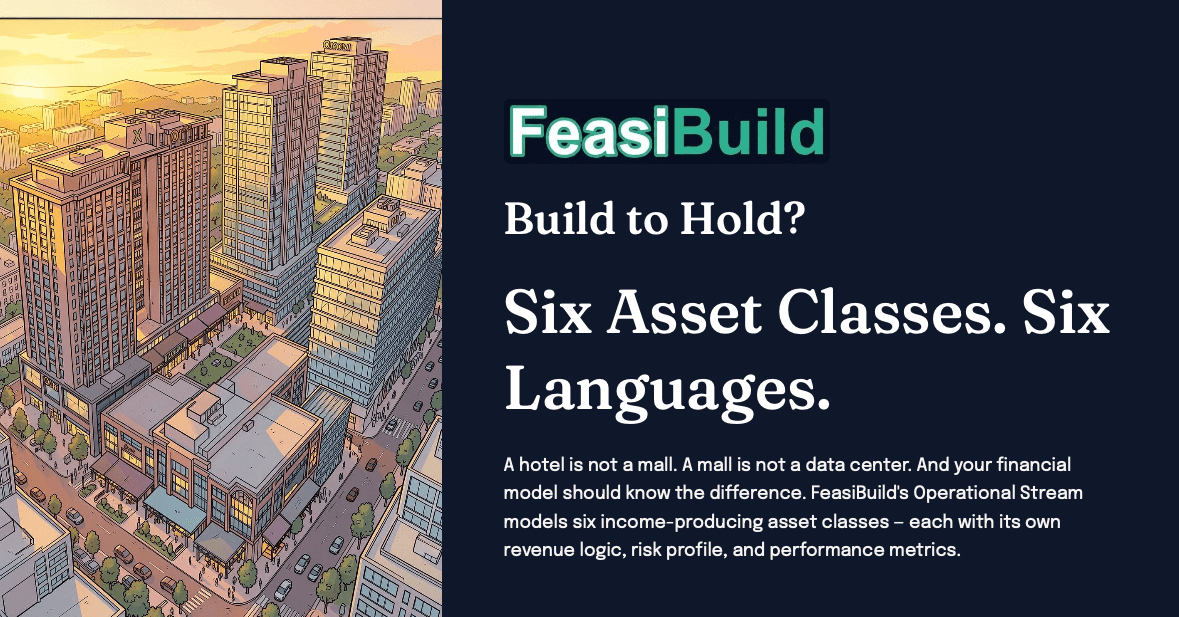
Build to hold? Six asset classes. Six languages.
Build-to-hold is not one model with a dropdown. A hotel lives on occupancy and ADR. A mall lives on occupancy, turnover rent, and tenant mix. A data centre lives on IT load, PUE, and contracted MW. If your feasibility study does not speak those languages, it is a cost sheet with an IRR attached.
The six languages
- Hotel — room mix, occupancy, ADR, departmental profit, undistributed expenses.
- Mall / retail — GLA, occupancy, base and turnover rent, CAM, tenant mix.
- Office — NLA, vacancy, rents, incentives, lease-up, yield on cost.
- Build-to-rent residential — unit mix, lease-up, other income, opex per key or per unit.
- Warehouse — GLA, rents, WALE-style occupancy, logistics cost drivers.
- Data centre — IT load, colocation or wholesale structure, power and cooling opex.
Same component path, different drivers
Every operational study still walks the same institutional path: cash outflows, cash inflows, financing, equity returns, scenario analysis, then the generated study. What changes is the segmentation and the revenue engine. That is how you keep IC-grade structure without flattening every asset into “rent × area”.
A hotel is not a mall. A mall is not a data centre. And your financial model should know the difference.
If you are holding the asset, start in the Operational Stream and pick the language the building actually speaks.
Slide deck
Download the slide deck (PDF)Run this analysis yourself — first report free at feasibuild.app
Start your first reportRelated posts
One engine. Eleven asset types. Two financial realities.
Most feasibility tools force every asset into the same spreadsheet. FeasiBuild doesn’t. Two distinct financial engines — built for the way each asset class actually performs.
5 Sep 2026 • 7 min read

Build to sell? Five ways to do it right.
Positioning isn’t a marketing word in a feasibility study — it’s a price quartile. And it changes every number downstream. FeasiBuild’s Sale Stream turns that insight into a structured underwriting engine.
28 Aug 2026 • 7 min read

Are You a Valuer, or an Excel Mechanic?
Most valuers and consultants are secretly overworked Excel mechanics. Here is how to get your weekends back and explode your margins.
24 Sep 2026 • 2 min read