
Build to sell? Five ways to do it right.
In a sale development, “luxury” is not a brand line. It is a price quartile, a buyer mix, and an absorption curve. Get the positioning wrong and every downstream number — GDV, peak funding, DSCR-equivalent cash coverage, equity cheques — is fiction.
Five ways to underwrite a sale scheme properly
- Treat positioning as a price quartile, not a brochure. ASP has to sit in a market band the city can actually absorb.
- Model payment plans and buyer mix. Cash buyers, mortgage buyers, and progress payments do not produce the same monthly cash.
- Align sales uptake with construction. Front-loaded, even, or back-loaded absorption changes peak funding more than a 2% cost tweak.
- Put escrow and gap-fill on the page. 10/90, staged escrow, or progress drawdown is a financing constraint, not a legal footnote.
- Stress discounts, commissions, VAT, and defaults before you lock land. Net sales proceeds — not headline GDV — pay the scheme.
What the Sale Stream actually models
Residential towers, landed product, commercial strata, and mixed-use. Development costs, sales revenue, unlevered project IRR, financing with escrow logic, levered equity returns, then scenarios. Typically a development horizon with no terminal value — returns come from costs versus net proceeds, not an exit cap rate borrowed from a hold model.
Positioning isn’t a marketing word in a feasibility study — it’s a price quartile. And it changes every number downstream.
Slide deck
Download the slide deck (PDF)Run this analysis yourself — first report free at feasibuild.app
Start your first reportRelated posts
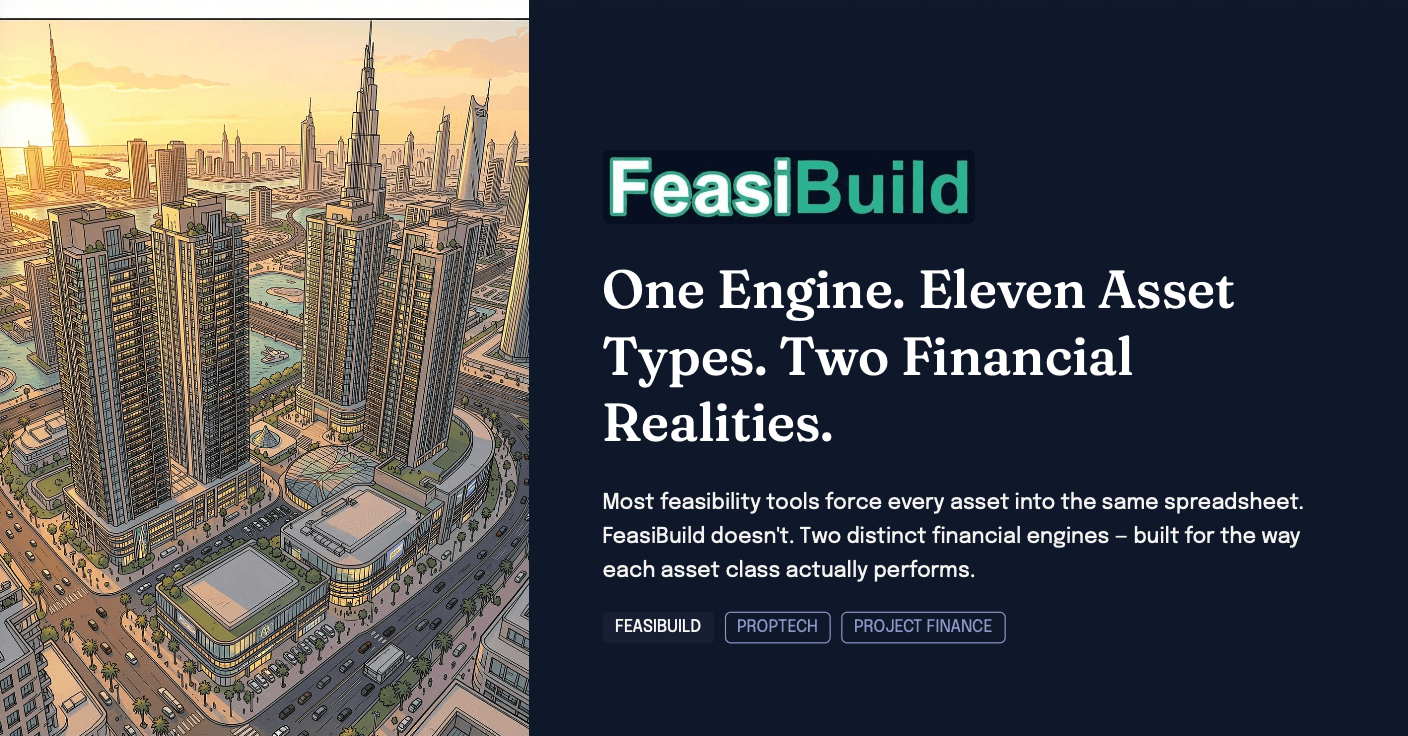
One engine. Eleven asset types. Two financial realities.
Most feasibility tools force every asset into the same spreadsheet. FeasiBuild doesn’t. Two distinct financial engines — built for the way each asset class actually performs.
5 Sep 2026 • 7 min read
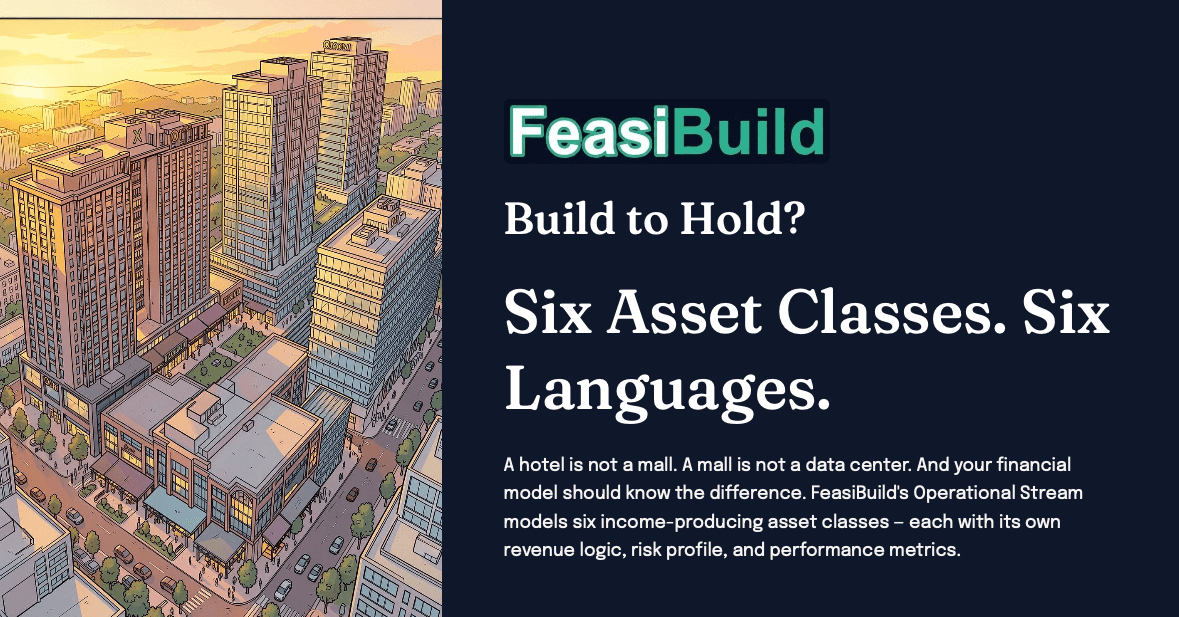
Build to hold? Six asset classes. Six languages.
A hotel is not a mall. A mall is not a data centre. FeasiBuild’s Operational Stream models six income-producing asset classes — each with its own revenue logic, risk profile, and performance metrics.
3 Sep 2026 • 8 min read

Are You a Valuer, or an Excel Mechanic?
Most valuers and consultants are secretly overworked Excel mechanics. Here is how to get your weekends back and explode your margins.
24 Sep 2026 • 2 min read