
Are You a Valuer, or an Excel Mechanic?
Most valuers and consultants are secretly overworked Excel mechanics.
You charge for your expertise, your judgment, and your market knowledge. But what do you actually spend 80% of your time doing?
- Fixing broken circular references
- Formatting PDF charts to look "professional"
- Manually updating generic templates for new jurisdictions
- Starting the model over when the client changes their mind on the unit mix
The 80/20 Problem
The dirty secret of the industry: Clients pay for the final 20% (the analysis). But you are burning your weekends doing the first 80% (the formatting).
The Workhorse's New Workflow
I built FeasiBuild specifically for the Workhorse.
You input the raw assumptions and the capital stack. The platform handles the jurisdiction logic (HDA, 10/90, Escrow), builds the dynamic financial waterfall, and auto-generates the bankable PDF report.
You get your weekends back. Your clients get faster turnaround. Your margins explode.
Slide deck
Download the slide deck (PDF)Run this analysis yourself — first report free at feasibuild.app
Start your first reportRelated posts
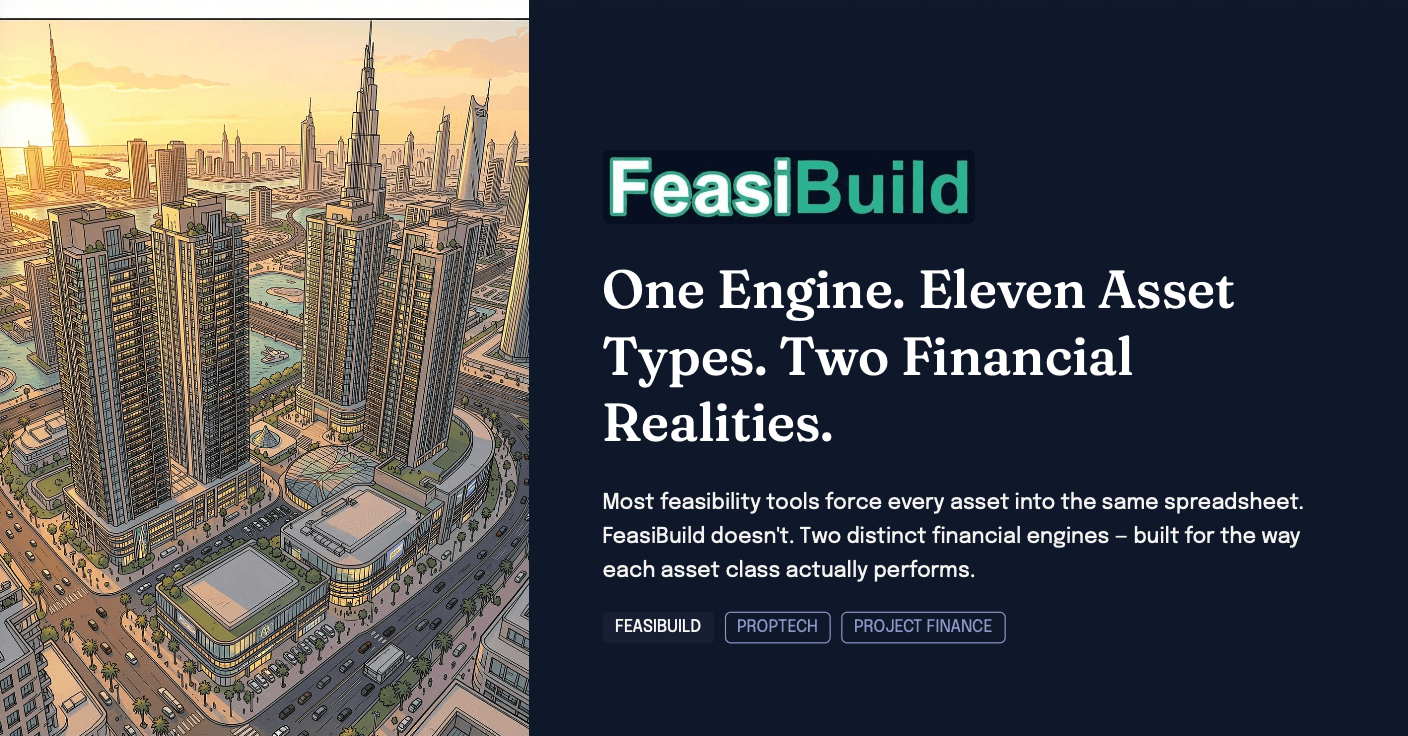
One engine. Eleven asset types. Two financial realities.
Most feasibility tools force every asset into the same spreadsheet. FeasiBuild doesn’t. Two distinct financial engines — built for the way each asset class actually performs.
5 Sep 2026 • 7 min read
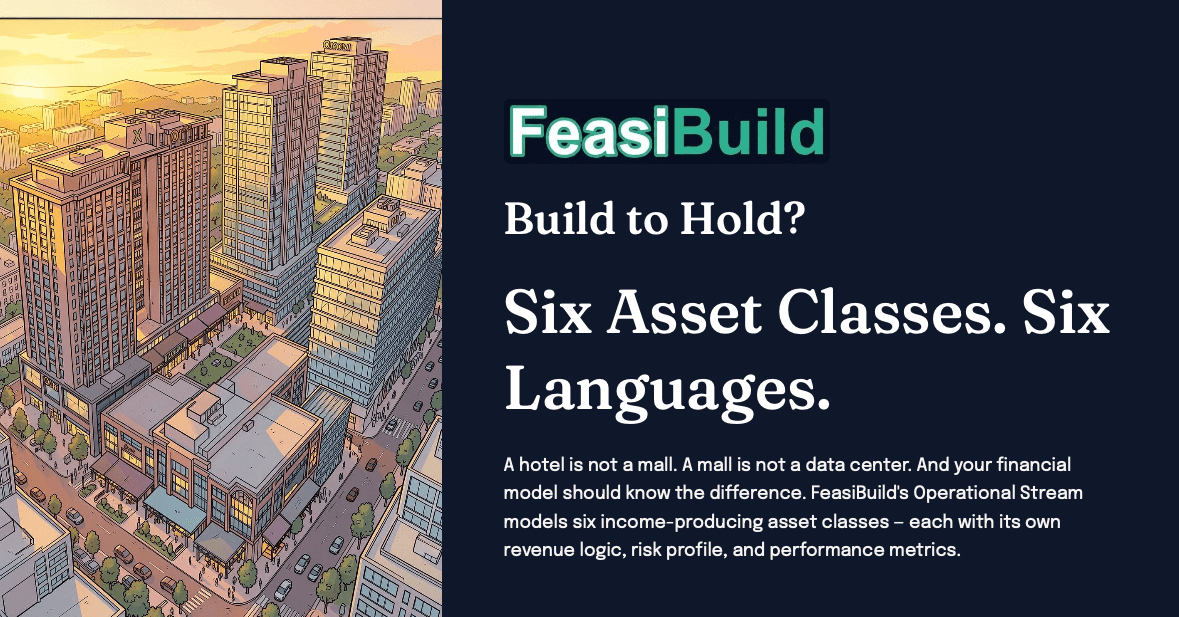
Build to hold? Six asset classes. Six languages.
A hotel is not a mall. A mall is not a data centre. FeasiBuild’s Operational Stream models six income-producing asset classes — each with its own revenue logic, risk profile, and performance metrics.
3 Sep 2026 • 8 min read

Build to sell? Five ways to do it right.
Positioning isn’t a marketing word in a feasibility study — it’s a price quartile. And it changes every number downstream. FeasiBuild’s Sale Stream turns that insight into a structured underwriting engine.
28 Aug 2026 • 7 min read