How to Present a Development to an Investment Committee
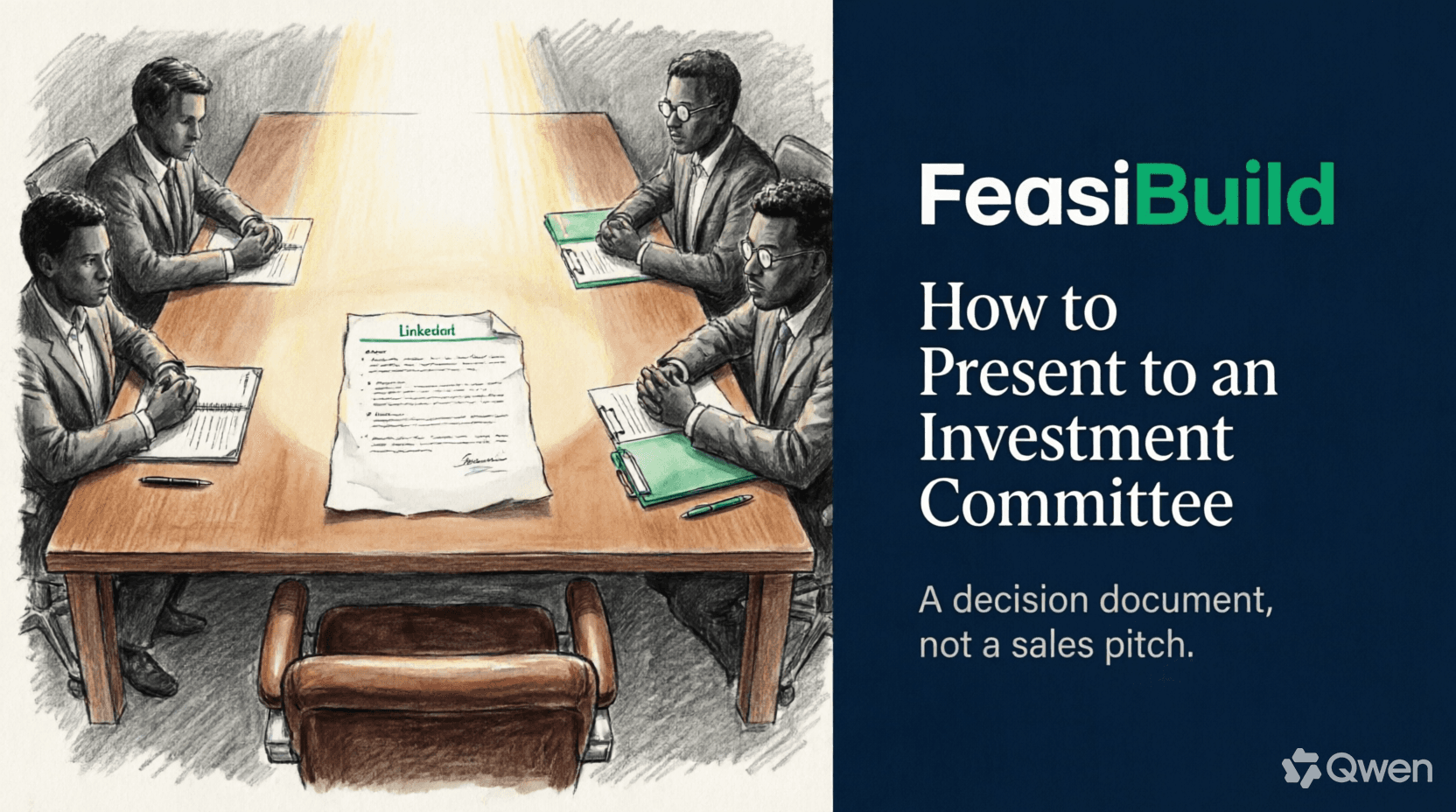
Direct answer: An investment committee presentation is a decision document, not a sales pitch. Open with the recommendation and the ask, support it with headline metrics and evidence in a fixed order — market, costs, returns, financing, risk — and present your own downside case before anyone asks for it. Committees approve deals whose sponsors understand how they can fail.
The committee is not your audience to impress. It is your audience to reassure.
1. Understand the room
Committee members are accountable for capital they don't own. Their professional risk is saying yes to a bad deal, not saying no to a good one. So the default posture in the room is scepticism — and your job is to make "yes" the low-risk choice. Every slide should answer an unspoken objection, not add another claim.
2. Structure the memo like a judgement, not a story
One-page summary first: recommendation, capital requested, headline returns (IRR and equity multiple), peak equity, key risks and mitigants. Then evidence in order: market and demand, development plan and cost stack, financial model and returns, financing structure, sensitivity and downside, appendices for depth. A committee that can navigate your pack in two minutes trusts it; one that has to hunt for the ask doesn't.
3. The first five minutes decide the meeting
State the recommendation and the ask in the first two sentences. Then give the three numbers that matter and the one risk you're watching. Sponsors who open with market colour lose the room to laptops; sponsors who open with the decision get questions instead of silence — and questions are engagement.
4. Bring the numbers that carry weight
IRR and equity multiple together (speed and scale). Peak equity and when it hits. DSCR and interest cover for any debt in the structure. A sensitivity table or tornado chart naming the variables that break the deal first. And the downside case, fully modelled — not a rhetorical "we've considered the risks."
5. Handle questions like an owner, not a presenter
Know every assumption and where it came from; be able to trace any number to its source in seconds. When you don't know, say so and commit to a date — bluffing is discovered, honesty is remembered. Keep deep-dive material in appendices so a challenge becomes a demonstration of preparation rather than a scramble.
6. Close the loop after the meeting
Minutes within 24 hours, action items with owners and dates, and any re-run cases delivered exactly as promised. Committees approve follow-on capital to sponsors whose post-meeting discipline matches their pre-meeting confidence. The second mandate is won in the follow-up.
Where most presenters get it wrong
Pitching like a roadshow: renders before returns, vision before viability. Hiding the downside until a member finds it — after which every number is suspect. Sixty slides in the main pack with no appendix strategy. Reading the deck aloud to people who read faster than you speak. And no clear ask: committees can't approve a vibe.
The workflow today
Assembling a committee-grade pack — consistent charts, tables, sensitivity runs and narrative — used to consume days of analyst formatting on top of the analysis itself. Modern AI-assisted tools generate the pack's mechanics in hours, which returns the team's scarce time to the only part that wins the room: the argument. Judgement, tone and candour remain human.
Key takeaways: Decision document, not sales pitch · Recommendation and ask in the first two sentences · Evidence in fixed order, depth in appendices · IRR + multiple + peak equity + DSCR, always together · Model your downside before they ask · The follow-up wins the next mandate.
A committee doesn't approve the deal you describe. It approves the sponsor who can describe how it fails — and still recommends it.
Related reading
How to Write a Real Estate Feasibility Study
The institutional structure of a bankable feasibility study — costs, revenues, financing, returns, scenarios, and the narrative an investment committee can actually interrogate.
IRR vs Equity Multiple Explained
Project IRR, equity IRR, and equity multiple answer different questions. How to read them together so an IC does not confuse speed of return with cash-on-cash scale.
FeasiBuild vs the Market in 2026
Consultancies, legacy desktop suites, regional SaaS, and generic AI: what each actually delivers, what they cost, and why two asset engines plus BYO infrastructure is a different product.