IRR vs Equity Multiple Explained
Direct answer: Internal Rate of Return (IRR) measures the annualized rate of return, heavily rewarding the speed at which capital is returned. Equity Multiple measures the total cash returned relative to the cash invested, ignoring time entirely. Because a quick flip and a long-term hold can produce identical IRRs but vastly different equity multiples, institutional investment committees require both metrics side-by-side to evaluate a deal.
There is an old saying in private equity: "You can't eat IRR." Developers and sponsors often chase the highest IRR to hit their performance hurdles, but if they ignore the equity multiple, they may build a portfolio that generates fantastic percentages but very little actual wealth.
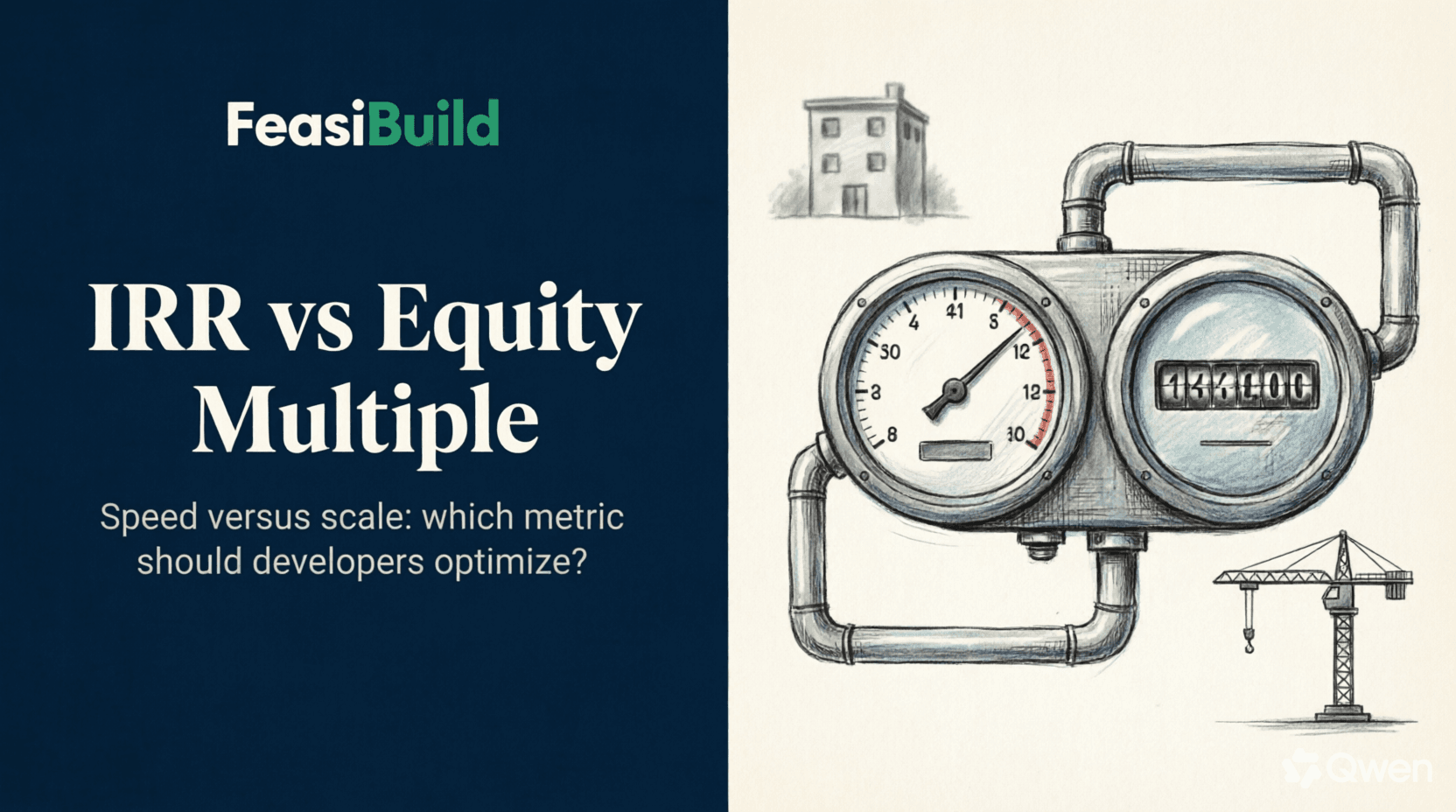
1. The IRR illusion (the speedometer)
IRR is a time-weighted metric. It looks at exactly when cash flows occur. Because of the time-value of money, returning capital quickly artificially inflates the IRR. If you buy a piece of land and flip it to another developer three months later for a 10% profit, your annualized IRR is roughly 40%. It looks incredible on a pitch deck. But you only made a 10% total profit on your money.
2. Equity multiple (the odometer)
Equity Multiple is brutally simple: Total Cash Distributions ÷ Total Equity Invested. If you put in $1 million and get back $2 million over 10 years, your equity multiple is 2.0x. It doesn't care if it took 2 years or 20 years. It only measures the absolute scale of the wealth created.
3. The classic conflict
Imagine two projects:
- Project A: A quick 18-month townhouse flip. You make a 15% margin. IRR = 25%. Equity Multiple = 1.15x.
- Project B: A 7-year build-to-rent apartment complex. You make a 60% total margin. IRR = 16%. Equity Multiple = 1.60x.
A junior analyst chasing IRR will pitch Project A. A seasoned fund manager looking to deploy $50 million and actually grow the fund's capital will heavily favor Project B.
4. The waterfall problem
The obsession with IRR creates a structural conflict in development joint ventures. Sponsors (developers) typically earn a "promote" (a disproportionate share of profits) once they hit a specific IRR hurdle (e.g., a 15% preferred return). To hit that hurdle faster and trigger their bonus early, a sponsor might be incentivized to sell an asset prematurely or refinance aggressively to return capital early, leaving very little long-term upside (equity multiple) for the passive investors.
5. What investment committees actually want
A credible feasibility study never presents IRR in isolation. It presents the base, upside, and downside cases for both metrics simultaneously. Furthermore, it includes a duration analysis — showing how the IRR decays if the project is held for 3, 5, or 7 years instead of selling at year 1. This proves to the committee that the developer understands the difference between a trading profit and an investment return.
6. The workflow today
Calculating IRR in a spreadsheet is straightforward for a single, static scenario. Calculating IRR and Equity Multiple simultaneously across three downside scenarios, while adjusting for changing debt-service schedules and delayed exit timelines, is where manual models typically break. Modern AI-assisted modeling engines recalculate both metrics instantly across the entire cashflow path, allowing developers to test exit timing without breaking the formulas.
Key takeaways: IRR measures speed, Equity Multiple measures scale · Quick flips inflate IRR but limit wealth creation · Long holds depress IRR but build the multiple · Beware of IRR-chasing in joint venture waterfalls · Always present both, alongside the hold-period timeline.
High IRR tells you how fast the money moves. High Equity Multiple tells you how much money actually arrived.
Related reading
DSCR Explained for Real Estate Developers
Debt service coverage ratio is how lenders test whether a scheme can pay its debt. What DSCR means, how it is calculated, and the levels credit committees actually look for.
What Goes in a Real Estate Development Financial Model
Land, construction, revenues, financing, waterfalls, and scenarios — the working parts of a development model, and why hold assets and sale schemes cannot share the same engine.
How to Present a Development to an Investment Committee
An IC does not want a novel. It wants a residual, a peak-funding path, named downside cases, and a pack that matches the model. How to walk a committee through a deal without losing the room.