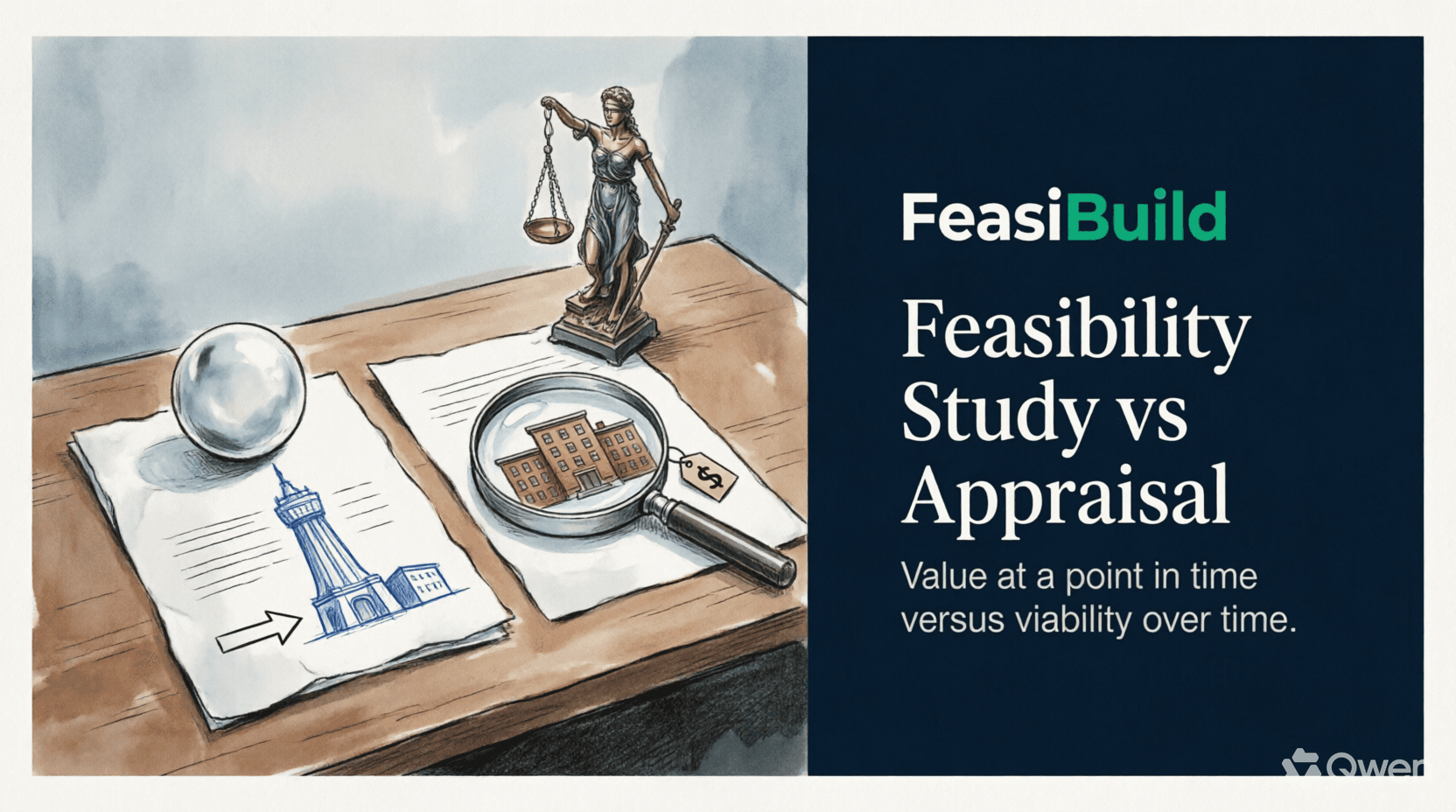
Feasibility Study vs Appraisal
Direct answer: An appraisal is an opinion of an asset's value at a point in time, based on market evidence and standard valuation methods. A feasibility study tests whether a proposed development will actually work — demand, costs, financing, returns and risk — before any capital is committed. Lenders usually require both: the feasibility study to judge viability, the appraisal to set the loan amount.
Developers routinely commission the wrong document first. Knowing which question each report answers saves weeks — and awkward committee meetings.
1. The appraisal: what is it worth?
A valuation prepared by a licensed or registered valuer under recognised standards (RICS, IVS or local equivalents). It leans on three classic approaches: sales comparison, income capitalisation, and cost. Its job is a defensible number for a transaction — purchase, refinancing, financial reporting, or dispute. It looks at evidence from the market as it exists.
2. The feasibility study: will it work?
A forward-looking analysis of a development that does not exist yet. It assembles assumptions, market demand, the financial model, the financing plan, risk analysis and an executive summary — and ends in a recommendation: proceed, restructure, or walk away. It doesn't just value an outcome; it tests the path to get there.
3. The timeline distinction — and the "as-if-complete" trap
Appraisals can be prepared "as-is" (the site today) or "as-if-complete" (the finished, stabilised asset). Development lenders rely heavily on the as-if-complete figure. Here's the nuance most people miss: an as-if-complete valuation assumes the project is delivered on time, on budget, and fully absorbed. It is an opinion of value, not a test of viability. Only the feasibility study tests the costs, timing and financing that the valuation quietly assumes.
4. Who prepares them, who reads them
Appraisals carry a valuer's signature and professional liability — banks and courts rely on them. Feasibility studies are prepared by developers, consultants or analysts, and are read by investment committees and credit teams who will interrogate every assumption. One is a certified opinion; the other is an argued case.
5. How they work together in a deal
In development finance, the two documents meet in the loan metrics. The feasibility study produces the cost stack, peak equity and coverage ratios; the appraisal provides as-is land value and as-if-complete value. The lender compares them: the gap between total development cost and as-if-complete value is the buffer that protects the loan. A useful bridge between the two is residual land value — what the feasibility math says the land is worth, checked against what the market and valuers say.
6. Getting the order right
Run feasibility first. If the numbers don't work, no valuation will save the deal — and you'll have paid for a report you don't need. Commission the formal appraisal when you're committing: at land acquisition, at loan application, or at refinancing.
Where most people get it wrong
Submitting an as-if-complete valuation as proof a project "works." Calling a market study a feasibility study (market analysis is one component, not the whole). And treating the appraiser's number as negotiable evidence rather than an independent opinion — committees notice when a developer shops for a valuation.
The workflow today
Assembling the feasibility case by hand — cashflows, scenarios, risk tables — is slow and fragile, while valuations remain a professional service. Modern AI-assisted modelling tools compress the feasibility side from weeks to hours, letting developers test viability before spending on formal valuations. The judgement, in both disciplines, stays human.
Key takeaways: Appraisal = value at a point in time · Feasibility = viability over time · "As-if-complete" is an assumption, not a test · Lenders need both, for different metrics · Residual land value bridges the two · Feasibility first, appraisal at commitment.
An appraisal tells you what an asset is worth. A feasibility study tells you whether it should exist at all.
Related reading
How to Write a Real Estate Feasibility Study
The institutional structure of a bankable feasibility study — costs, revenues, financing, returns, scenarios, and the narrative an investment committee can actually interrogate.
What Goes in a Real Estate Development Financial Model
Land, construction, revenues, financing, waterfalls, and scenarios — the working parts of a development model, and why hold assets and sale schemes cannot share the same engine.
How to Present a Development to an Investment Committee
An IC does not want a novel. It wants a residual, a peak-funding path, named downside cases, and a pack that matches the model. How to walk a committee through a deal without losing the room.