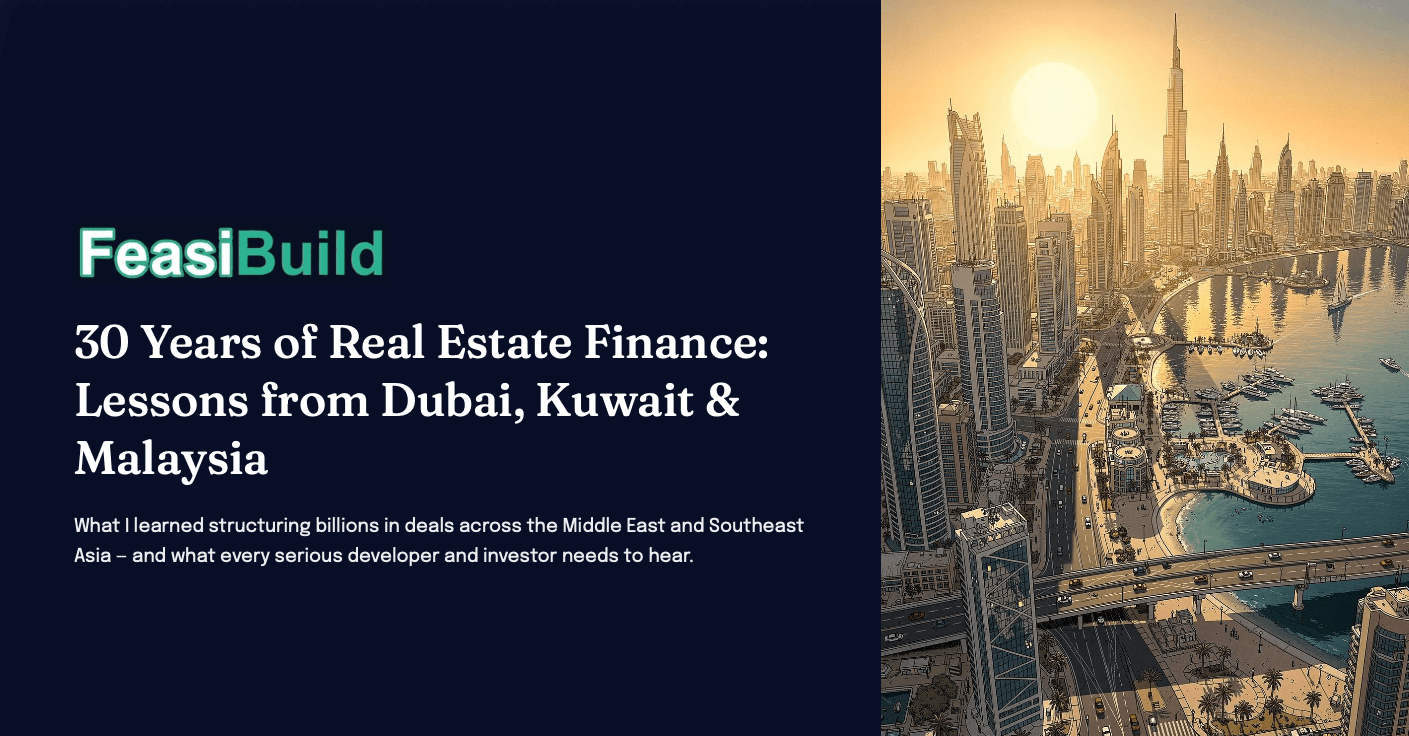
30 years of real estate finance: lessons from Dubai, Kuwait & Malaysia
I have spent three decades structuring real estate finance across the Gulf and Southeast Asia — construction funds in Saudi, recoveries in Dubai, mall financing in Oman, a business trust in Singapore. The jurisdictions differ. The mistakes rhyme.
What the cycles teach
- Dubai — liquidity and narrative can outrun cash. Peak funding, escrow, and a real downside absorption case are not optional.
- Kuwait and the wider GCC — capital is relationship-driven, but the model still has to survive a credit paper. Structure beats a handshake when the cycle turns.
- Malaysia and Singapore — process and disclosure are tighter. A study that cannot explain its drivers does not get through.
- Saudi construction finance — Shari’ah structure is a first-class constraint. You model it, or you do not have a facility.
What every developer should take from this
Jurisdiction is not a flag on the cover slide. It is escrow rules, tax, funding customs, and what a local IC will accept as evidence. A generic global template fails in Ras Al Khaimah the same way it fails in Johor — just for different reasons.
What I learned structuring billions in deals is that the model has to speak the market’s language — or the financing will not.
FeasiBuild exists to put that jurisdictional discipline into software: city-aware research, asset-specific engines, and a pack you can actually take to a bank in Dubai, Kuala Lumpur, or London.
Slide deck
Download the slide deck (PDF)Run this analysis yourself — first report free at feasibuild.app
Start your first reportRelated posts
The 6 components of an institutional-grade feasibility study
What separates a professional study from a back-of-napkin calculation — and why it matters for every development decision you make.
15 Aug 2026 • 8 min read
5 AI trends transforming real estate finance in 2026
The industry is evolving fast. Are you keeping up? Five shifts that are already changing how developments get underwritten.
12 Jul 2026 • 7 min read
The founder’s journey: from investment banking to AI startup
How 30 years of real estate finance across the Gulf and Southeast Asia led to building FeasiBuild — and why the industry will never be the same.
20 Jun 2026 • 8 min read